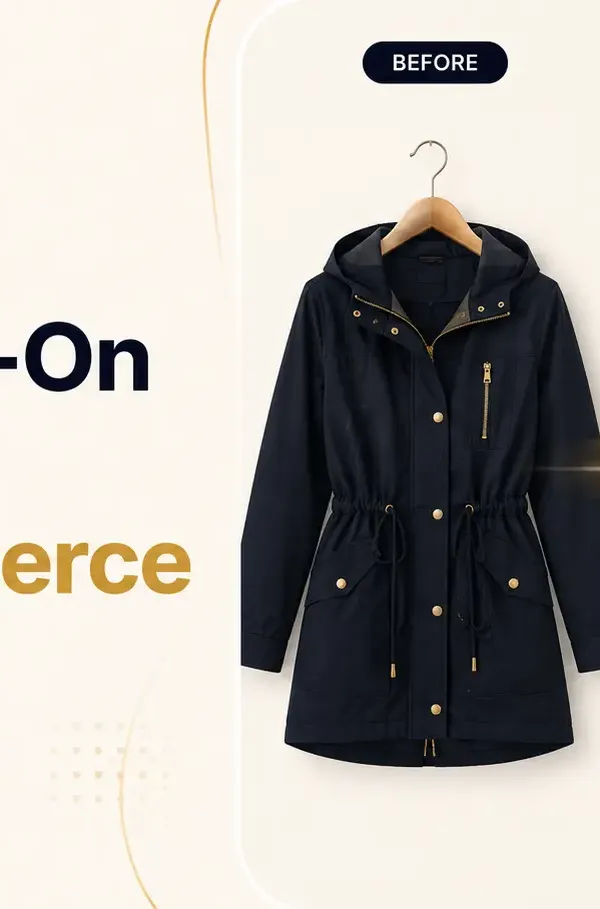
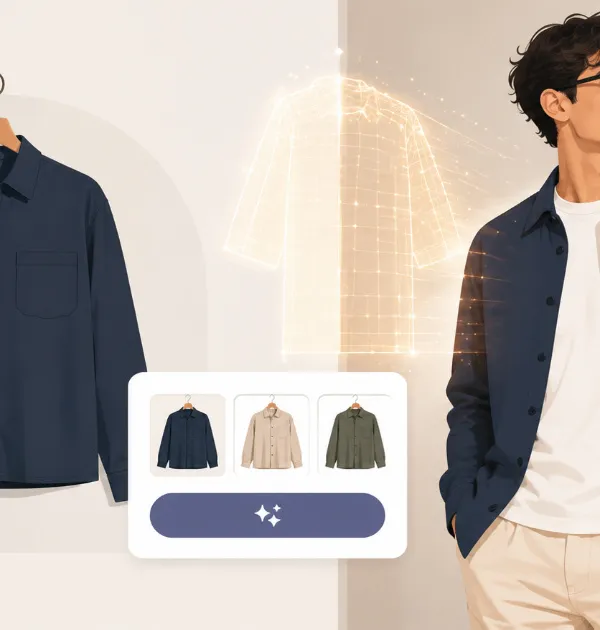
Virtual Try-On: How AI Lets You Try Clothes Online
Learn how AI virtual try-on works, how shoppers can try clothes online, and how fashion ecommerce stores can use virtual fitting technology to improve the shopping experience.
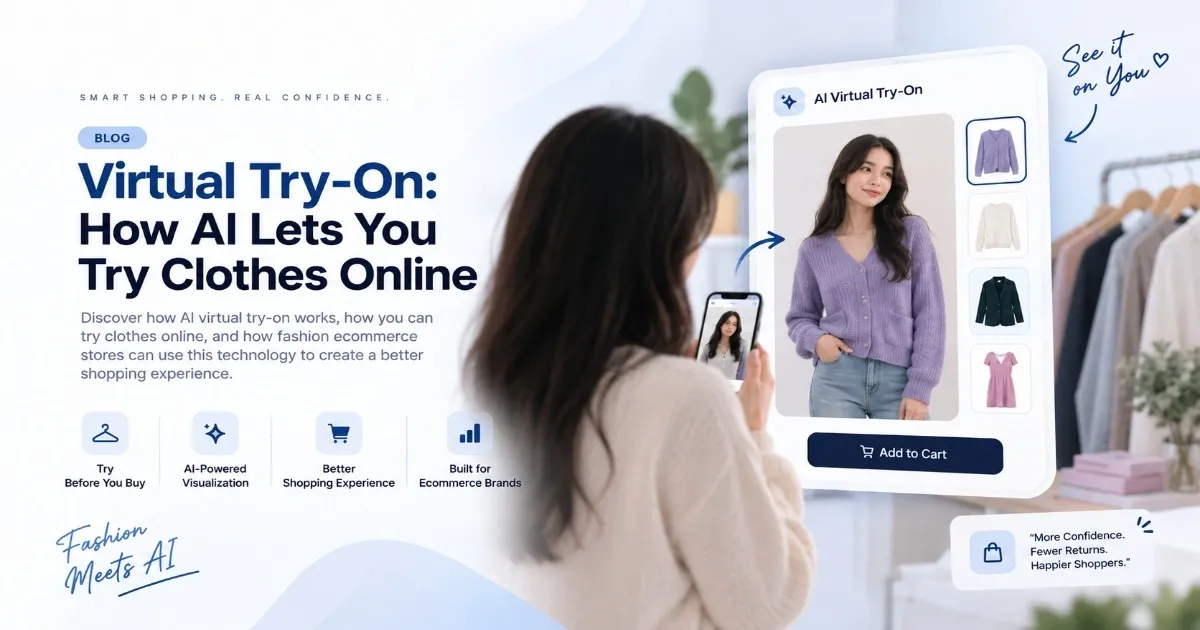
Online clothing shopping has one built-in challenge: shoppers cannot physically try a garment before buying it. Virtual try-on helps address that challenge by letting shoppers preview how clothing may look on them using AI.
With an AI virtual try-on experience, a shopper can upload a photo or selfie and generate a visualization of themselves wearing a garment. For fashion ecommerce stores, this creates a more interactive product experience and gives shoppers another visual reference before making a purchase.
This guide explains what virtual try-on is, how AI virtual try-on works, how to try clothes online, and how ecommerce stores can add the technology to their product pages.
What Is Virtual Try-On?
Virtual try-on is technology that lets a person preview how a product may look on them without physically wearing it.
Older experiences often relied on augmented reality (AR) overlays that placed a digital representation of a product over a live camera view. Modern AI virtual try-on can work differently: generative AI can create a new visualization of a shopper wearing a garment, including visual details such as fabric appearance, shadows, and lighting.
The basic benefit is simple: instead of relying entirely on imagination, shoppers get a personalized visual reference before purchasing.
For merchants, virtual try-on can make product pages more interactive and help address uncertainty around how clothing may look on a shopper.
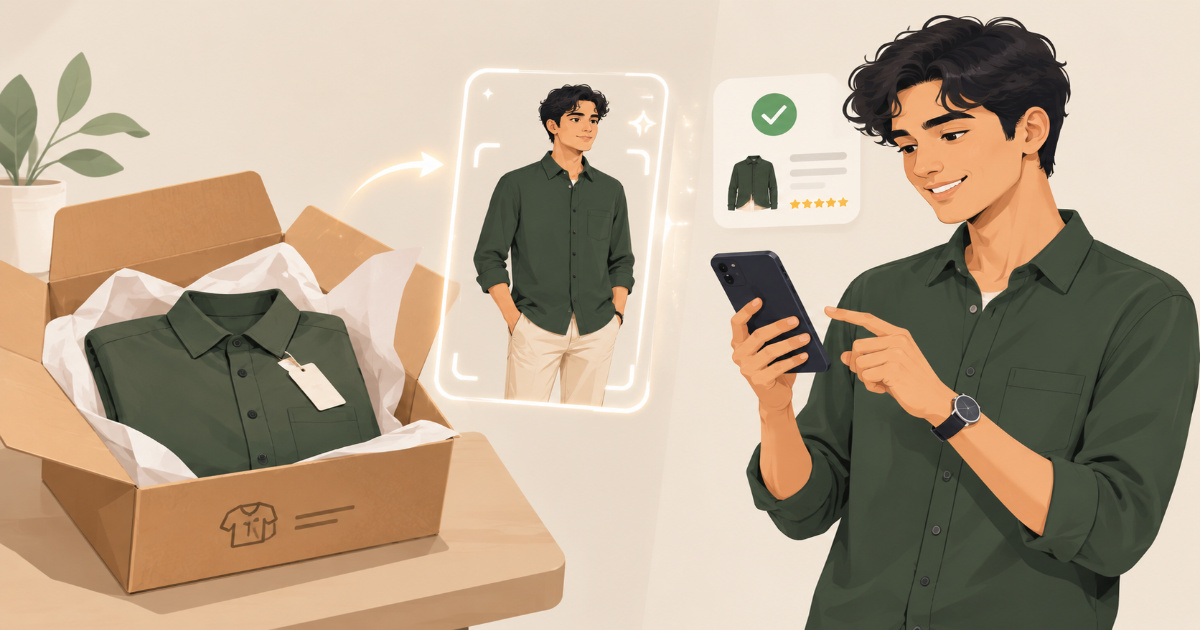
How Does AI Virtual Try-On Work?
An AI fashion try-on system has to combine a product image with a shopper's photo and generate a believable visualization of the garment on that person.
A typical workflow includes four main steps.
1. The Shopper Uploads a Photo
The shopper opens a product page, clicks the try-on option, and uploads a suitable photo or selfie.
A clear, well-lit photo generally provides a better starting point for the generated result.
2. The AI Analyzes the Shopper Image
The system analyzes visual information from the shopper's photo, including the person's pose, position, and relevant body areas.
This helps the system determine how the garment should be represented on that particular shopper rather than on a stock model.
3. The Garment Is Applied to the Visualization
The system uses the clothing product image together with the shopper image to generate the try-on result.
Modern generative AI techniques can produce a new image in which the garment is visually integrated with the shopper, including details such as fabric appearance, shadows, and lighting.
4. A Personalized Preview Appears
The shopper receives a generated image showing the clothing on them.
Depending on the implementation, the result can appear directly on the product page, allowing the shopper to continue browsing without leaving the shopping experience.
What Can and Can't a Virtual Try-On Result Tell You?
A virtual fitting room can help answer an important question:
"How might this garment look on me?"
It should not be treated as a guarantee of exact physical fit or sizing.
Actual fit can still depend on factors such as:
Garment measurements
Fabric stretch
Brand-specific sizing
Body measurements
How the garment feels when worn
The accuracy and quality of the input image
For that reason, shoppers should use the virtual try-on result together with the product's size chart, measurements, reviews, and other product information.
The quality of the input photo also matters. A clear, well-lit, front-facing image is generally a better starting point than a blurry, heavily filtered, or poorly cropped photo.
How to Try Clothes Online With AI
If you want to try clothes online using AI, the process is usually straightforward.
Step 1: Choose a Clothing Product
Open the product page for a garment you are interested in.
Step 2: Select the Virtual Try-On Option
Look for a button or control such as Try It On.
Step 3: Upload a Photo
Use a clear photo that provides enough visual information for the AI system.
For better results, avoid very dark photos, group photos, heavy filters, or images where the relevant body area is hidden.
Step 4: Generate the Try-On Result
The AI processes the shopper image and clothing product to generate an on-body visualization.
Step 5: Use the Result Alongside Product Information
Compare the generated result with the product photography, size chart, measurements, reviews, and return policy.
Virtual try-on is best used as an additional decision-making tool rather than a replacement for sizing information.
Virtual Try-On vs. Traditional Product Photos
Traditional ecommerce product photography shows a garment on a model, mannequin, or product background.
This provides useful information, but shoppers still have to imagine how the garment might look on them.
Virtual try-on adds another layer of personalization.
Traditional Product Page | Virtual Try-On |
|---|---|
Product or model photography | Personalized on-body visualization |
Shopper imagines themselves wearing the item | Shopper sees an AI-generated preview |
Same product images are shown to shoppers | Visualization uses a shopper-provided photo |
Limited personalization | More personalized visual experience |
Virtual try-on does not need to replace professional product photography. It can complement existing product images by giving shoppers another way to evaluate a garment.
Virtual Try-On vs. AR
Virtual try-on and augmented reality can provide different experiences.
AR commonly overlays or positions digital content onto a live camera view.
AI virtual try-on can use generative models to create a new visualization of a person wearing a product.
The important question for an ecommerce merchant is not simply whether the experience uses AR or AI. It is whether the experience:
Helps shoppers understand the product
Is easy to use
Works well on mobile devices
Fits naturally into the shopping journey
Gives shoppers useful information before they buy
Virtual Try-On for Ecommerce
Virtual try-on is especially relevant to ecommerce categories where appearance and fit influence purchase decisions.
For fashion stores, shoppers often want to answer a simple question:
"How might this look on me?"
A traditional product photo can show what a garment looks like.
A virtual try-on experience can provide an additional, personalized visualization.
This can be useful for:
Fashion ecommerce stores
Clothing brands
Direct-to-consumer fashion stores
Shopify apparel stores
Online boutiques
Multi-brand fashion retailers
Why Do Fashion Stores Add Virtual Try-On?
Merchants can use virtual try-on to create a more interactive shopping experience and give shoppers another way to evaluate products.
Potential benefits include:
Helping shoppers visualize clothing on themselves
Increasing purchase confidence
Creating a more engaging product-page experience
Reducing reliance on imagination when evaluating clothing
Adding personalization to the shopping journey
Giving merchants another product-engagement signal to measure
The exact business impact varies by store, product category, audience, traffic, product photography, and implementation.
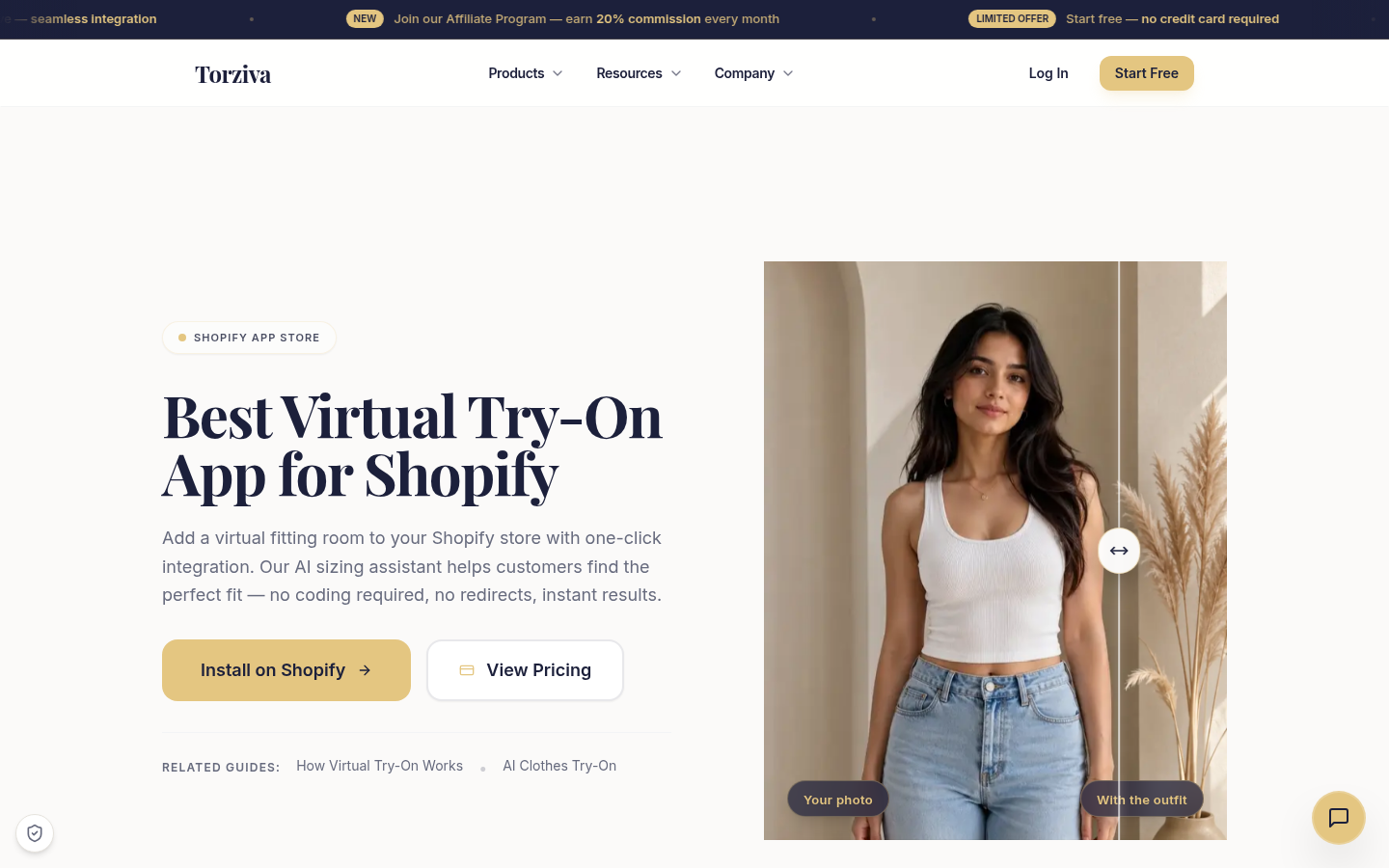
Virtual Try-On for Shopify
Shopify merchants can add AI virtual try-on to supported fashion products and place the experience directly on product pages.
Torziva is designed for Shopify merchants and ecommerce brands. Its try-on experience lets shoppers upload a photo and generate an AI clothing preview while staying within the product-page shopping experience.
A typical Torziva flow is:
Product page → Try It On → Upload photo → AI generation → On-body preview → Continue shopping
This keeps the try-on experience connected to the product the shopper is already considering.
Why Add Virtual Try-On to a Shopify Store?
A Shopify merchant can use virtual try-on to:
Give shoppers another way to visualize products
Create a more interactive product-page experience
Help shoppers evaluate how clothing may look on them
Add a personalized experience without requiring shoppers to leave the product page
Measure how try-on engagement relates to ecommerce performance
[Learn more about AI virtual try-on for Shopify →]
How to Add AI Virtual Try-On to a Shopify Store
The exact setup depends on the implementation, but a typical ecommerce workflow looks like this:
Create or connect your Torziva account.
Install the Torziva Shopify integration.
Enable the try-on experience for supported products.
Test the experience on a real product page.
Test the experience on mobile devices.
Monitor try-on usage and ecommerce performance.
Optimize the experience based on what shoppers actually do.
Before making the experience widely available, merchants should test the complete shopper journey—from clicking Try It On to generating the result and continuing toward purchase.
[Install Torziva on Shopify →]
What Types of Clothes Work With Virtual Try-On?
The supported categories depend on the virtual try-on system.
Torziva's current try-on experience supports:
Tops and shirts
Bottoms
Dresses
Outerwear
Merchants should check the latest Torziva product documentation before enabling additional categories.
How to Get Better Virtual Try-On Results
Use Clear Product Images
High-quality product photography gives the system better visual information about the garment.
Use a Suitable Shopper Photo
A clear, well-lit photo with a useful view of the shopper generally provides a better starting point.
Start With Your Best Products
Merchants can begin with products that have strong product photography and meaningful customer traffic, then expand based on results.
Test the Real Shopping Experience
Test the try-on experience on the actual storefront, including mobile devices.
Check:
Button visibility
Photo upload flow
Generation speed
Result quality
Product-page layout
Mobile usability
Measure What Changes
Track how shoppers interact with the feature and compare relevant ecommerce metrics before and after implementation.
Useful metrics include:
Try-on usage
Product engagement
Add-to-cart rate
Conversion rate
Return rate
Revenue per visitor
Revenue per product
Can Virtual Try-On Reduce Fashion Returns?
Virtual try-on can help reduce uncertainty around online clothing purchases by giving shoppers an additional visual reference before buying.
Torziva reports an average reduction in size-related returns among merchants using its widget. Actual results can vary depending on factors such as product selection, product photography, shopper behavior, traffic, and store implementation.
For that reason, merchants should measure their own results rather than assume a fixed return-rate reduction.
Can Virtual Try-On Increase Ecommerce Conversion?
It can potentially help improve purchase confidence by giving shoppers another way to visualize a product before buying.
Torziva reports an average conversion lift for merchants using its widget. Actual performance varies by store and implementation, so merchants should use their own analytics to measure the impact.
Useful measurements include:
Try-on engagement
Add-to-cart rate
Conversion rate
Return rate
Revenue per visitor
Does Virtual Try-On Guarantee Fit or Size?
No.
A virtual try-on visualization is not a guarantee of exact physical fit, measurements, or sizing.
Shoppers should still consider:
Size charts
Product measurements
Fabric and stretch
Customer reviews
Fit notes
Return and exchange policies
Virtual try-on is best understood as a visual confidence tool that complements traditional sizing information.
Is Virtual Try-On Safe for Shopper Photos?
Privacy is an important consideration whenever an ecommerce experience asks shoppers to upload personal photos.
Torziva states that shopper photos are processed in real time and not stored on its servers. Merchants and shoppers should always check the current Torziva privacy policy for the latest details.
For AI shopping experiences involving uploaded images, merchants should clearly explain:
Why the image is needed
How it is processed
Whether it is stored
How long it is retained
Whether it is used for model training
Where shoppers can find the applicable privacy information
Virtual Try-On vs. Virtual Fitting Room
The terms virtual try-on and virtual fitting room are often used interchangeably, but they can describe slightly different experiences.
Virtual try-on generally focuses on generating a visualization of a product on the shopper.
Virtual fitting room is a broader term that can describe a digital shopping experience designed to help customers explore products and make purchase decisions.
A virtual try-on feature can therefore be one part of a broader virtual fitting-room experience.
Common Virtual Try-On Mistakes
1. Using Poor-Quality Images
Low-quality product or shopper images can make the generated visualization less useful.
2. Enabling Unsupported Categories
Only enable virtual try-on for product categories supported by the implementation.
3. Hiding the Try-On Button
If shoppers cannot easily find the feature, they are less likely to use it.
Keep the try-on action visible and clearly labeled.
4. Treating the AI Result as a Size Guarantee
A generated image does not replace a size chart or product measurements.
5. Measuring Nothing
If you add virtual try-on to an ecommerce store, track whether shoppers use it and whether it affects important business metrics.
6. Ignoring Mobile Experience
Test the complete try-on flow on phones as well as desktop devices.
Frequently Asked Questions
What is virtual try-on?
Virtual try-on is technology that lets a shopper preview how a product may look on them without physically wearing it. AI virtual try-on can use a shopper's photo and product imagery to generate an on-body visualization.
How does AI virtual try-on work?
The system analyzes a shopper's image and the clothing product, then generates a visualization of the garment on the shopper.
Can I try clothes online?
Yes. Some ecommerce stores use AI virtual try-on to let shoppers upload a photo and preview clothing on themselves before purchasing.
What is a virtual fitting room?
A virtual fitting room is a digital shopping experience that helps shoppers evaluate products visually without physically trying them on in a traditional store.
Is virtual try-on the same as AR?
No. AR commonly overlays digital content onto a live camera view, while AI virtual try-on can use generative AI to create a new visualization of a shopper wearing a product.
Is virtual try-on accurate?
Virtual try-on can provide a useful visual reference, but it should not be treated as an exact guarantee of physical fit, measurements, or sizing.
Do I need to download an app to use virtual try-on?
Not necessarily. Product-page virtual try-on experiences can run in the browser, depending on the implementation. Torziva's product-page experience is designed to keep the shopper within the ecommerce shopping flow.
Can Shopify stores use virtual try-on?
Yes. Shopify merchants can add AI virtual try-on to supported fashion products. Torziva provides a Shopify integration designed to add try-on functionality to product pages.
What clothing categories work with Torziva?
Torziva's current try-on experience supports tops and shirts, bottoms, dresses, and outerwear. Merchants should check the latest Torziva documentation for current category support.
Can virtual try-on reduce returns?
It may help reduce uncertainty around online clothing purchases and can potentially contribute to fewer size- or fit-related returns. Torziva reports an average reduction in size-related returns among merchants using its widget, although individual results vary.
Can virtual try-on increase conversions?
It can potentially improve purchase confidence and product engagement. Torziva reports an average conversion lift for merchants using its widget, but actual results vary by store, audience, products, and implementation.
Are shopper photos stored?
Torziva states that shopper photos are processed in real time and not stored on its servers. Always check the current Torziva privacy policy for the latest information.
Is there a free virtual try-on option?
Torziva offers a Free plan. Plan limits and features can change, so merchants should check the current pricing page for the latest details.
The Future of Online Fashion Shopping
Online fashion shopping has one major limitation: shoppers cannot physically try a garment before purchasing it.
Virtual try-on does not completely replace physical fitting, but it can make the digital shopping experience more visual and personalized.
As AI-powered shopping experiences continue to develop, virtual try-on can become another useful layer between browsing and buying.
For fashion merchants, the goal is not simply to add another AI feature.
The goal is to help shoppers understand products and make more confident purchase decisions.
Try AI Virtual Try-On With Torziva
Torziva brings AI virtual try-on directly into the ecommerce shopping experience.
For supported fashion products, shoppers can upload a photo and generate an AI-powered visualization while staying within the product-page experience.
If you run a Shopify fashion store and want to let customers visualize clothing before they buy, you can start with Torziva.
Explore AI Virtual Try-On for Shopify →
Related Resources
Was this article helpful?
Your feedback helps us improve our content quality.
Admin
Verified ContributorFounder & AI Ecommerce Specialist
Torziva helps fashion ecommerce brands use AI virtual try-on technology to create better online shopping experiences and help customers visualize clothing before they buy.